
Is Orton-Gillingham effective? What the research says
Many states have written this dyslexia method into law. But is it more effective than other methods?
See it, say it, trace it
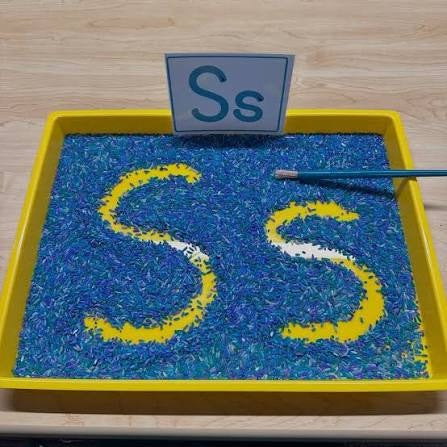
It’s called Orton-Gillingham, and its signature is multisensory teaching. See the letter, say the sound, trace it in the sand.
The idea is about a hundred years old. In the 1920s Grace Fernald had struggling readers trace words with a finger while saying them aloud, and the neurologist Samuel Orton built on it: link what a child sees, hears and does with their hands, and the letter-sound connection should stick. Anna Gillingham, an educator who worked with Orton, turned it into the direct, structured, step-by-step lessons that carry both their names (Austin et al., 2023).
Over the past decade, parent advocacy groups pushed most states to pass reading legislation, and many of those laws name Orton-Gillingham specifically (Stevens et al., 2021).
What the studies found
- 2021. Researchers pooled the Orton-Gillingham studies, and those programs didn’t reliably beat other reading instruction. Across 24 studies the average effect leaned positive, but it wasn’t statistically different from the comparison instruction (Stevens et al., 2021).
- 2023. A review of 40 years of dyslexia programs (53 studies, more than 6,000 students) found that the ones billed as multisensory did no better than the rest (Hall et al., 2023).
- 2025. An experiment with preschoolers found that sandpaper letters and hand gestures didn’t clearly add anything over plain tracing and writing on paper. Both ways of teaching the alphabet helped (Park, Piasta & Sayer, 2025).
None of this says Orton-Gillingham doesn’t work. Kids in these programs usually do make progress. The question is whether they do better than kids getting other solid reading instruction, and so far the answer is “not clearly.” Some studies found benefits that didn’t reach statistical significance, but most of those studies were small, and small studies often miss modest effects (Stevens et al., 2021). As the researchers who reviewed it put it, absence of evidence isn’t evidence of absence (Austin et al., 2023).
So why the mixed results?
Orton-Gillingham is defined by five features. Researchers went through them one by one, and four have strong evidence behind them (Austin et al., 2023):
- Direct and explicit. The teacher models each skill, then guides practice, with lots of chances to respond and get feedback. Strong evidence.
- Structured and sequential. Skills come in a set order, simple to complex, with constant review of old ones. Strong evidence.
- Diagnostic. The teacher tracks how the child responds, every lesson. Strong evidence.
- Prescriptive. Each lesson targets what tripped the child up last time. Strong evidence.
- Multisensory. Seeing, hearing and moving at the same time: sand trays, finger tapping, writing in the air. While kids learn letters better by writing than typing (Ibaibarriaga, Acha & Perea, 2025), there’s little evidence sand or texture adds anything over pencil and paper (Park, Piasta & Sayer, 2025; Austin et al., 2023).
That’s likely why Orton-Gillingham helps: the four evidence-based features do the heavy lifting. Many other strong reading programs share those four too, which may be why head-to-head studies haven’t found a clear winner. The multisensory part is what Orton-Gillingham is best known for, but it’s the part with the least research behind it so far.
One more ingredient is time. In the 40-year review, the amount of instruction was one of the only things that reliably went with bigger gains, while the multisensory label didn’t (Hall et al., 2023).
This is where individualization matters. If a sand tray keeps your child engaged long enough to practice more, it’s worth it for the extra hours alone.
Questions to ask a tutor or school
- Do you teach letter-sound patterns explicitly, in a set order, and review the old ones?
- Does my child spell and write words in every session, not just read them?
- How many hours a week will my child practice, and for how many months?
- How do you track progress, and what do you change when it stalls?
If they teach patterns in order, include writing, schedule plenty of hours, and adjust when progress stalls, your child is getting the parts that matter most.
What to do now
We still need bigger, better trials. Until then: sand or pencil, whatever keeps your kid engaged. Just don’t skip the basics.
Sources
- Stevens, E. A., Austin, C., Moore, C., Scammacca, N., Boucher, A. N., & Vaughn, S. (2021). Current state of the evidence: Examining the effects of Orton-Gillingham reading interventions for students with or at risk for word-level reading disabilities. Exceptional Children. doi:10.1177/0014402921993406
- Hall, C., Dahl-Leonard, K., Cho, E., Solari, E. J., Capin, P., Conner, C. L., et al. (2023). Forty years of reading intervention research for elementary students with or at risk for dyslexia: A systematic review and meta-analysis. Reading Research Quarterly, 58(2), 285–312. doi:10.1002/rrq.477
- Park, S., Piasta, S. B., & Sayer, P. M. (2025). An initial yet rigorous test of multisensory alphabet instruction for English monolingual and emergent bilingual children. Early Childhood Research Quarterly, 72, 328–338. doi:10.1016/j.ecresq.2025.04.008
- Ibaibarriaga, G., Acha, J., & Perea, M. (2025). The impact of handwriting and typing practice in children’s letter and word learning: Implications for literacy development. Journal of Experimental Child Psychology, 253, 106195. doi:10.1016/j.jecp.2025.106195
- Austin, C., Stevens, E., Demchak, A., & Solari, E. (2023). Orton-Gillingham: Which aspects are supported by research and which require additional research? The Reading League Journal, 4(3), 5–15.