



Pre-orders are open! Ships in 2027.

A plasticity-boosting headband for children struggling to read.

Some children spend years in tutoring and still read below grade level. NeuroLingo is a headband that sends a very low current to the brain’s reading areas during practice, so tutoring has more to build on. In multiple trials, children with dyslexia read unfamiliar words faster and more accurately.

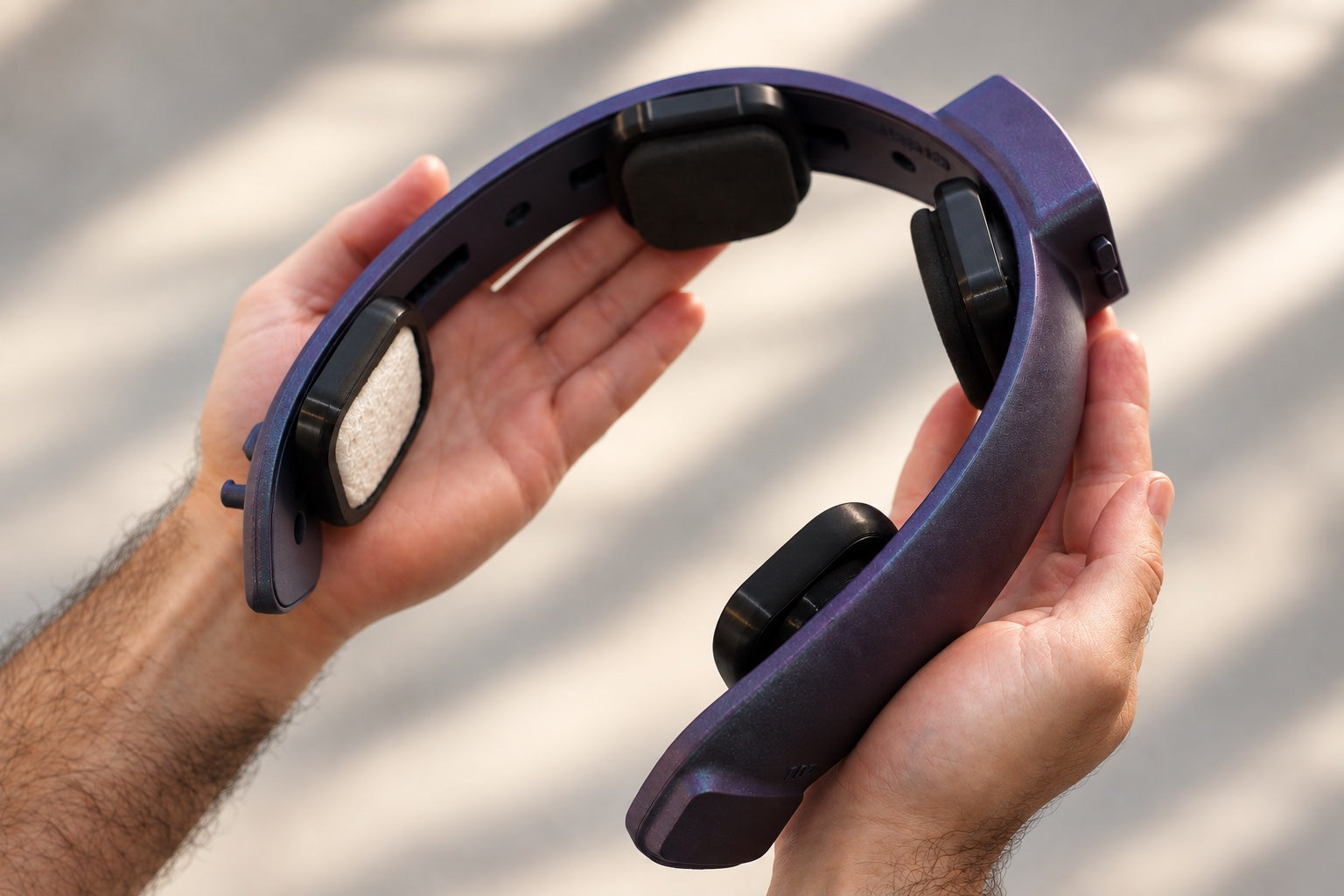
Two hands holding the NeuroLingo headband
Founded at Yale
Backed by SOSV / HAX
Competed in TechCrunch

Made for the years when reading is hard work.

Some children work twice as hard as their classmates to read, and progress comes slowly. NeuroLingo is for those children, ages 6 to 17, who are already doing the work: a tutor, a reading program at school, a structured program at home. It is not a replacement for any of that. It is worn during the practice they already do.

Ages 6 to 17.

The range NeuroLingo is designed and studied for.

Works with any reading program.

Orton-Gillingham, Wilson, Barton, Lindamood-Bell, your school’s program, or reading with you at the kitchen table.

20 minutes, at least three times a week.

During the reading practice already on the calendar.

How it works

Twenty minutes, during reading practice.

  1. Insert the pads and slide it on.

    The headband comes with packs of saline pads (similar to moist makeup remover pads). You’ll push those into the headband and slide it on like a pair of glasses.

  2. Start a session.

    The headband delivers a gentle, low-level current to the parts of the brain involved in reading. Most people describe a light tingle for the first few minutes while the nerves in the skin get used to the sensation.

  3. Read as usual.

    It’s important your child does their normal literacy practice. The headband does not teach reading. The practice does. If your child is studying literacy for hours a day, pair the headband with the most difficult part of their practice.

  4. Keep your study routine!

    Effects shown in the scientific literature consistently build over time with regular use. The studies below show regular usage of three times a week to have positive outcomes.

What the research says.

Non-invasive brain stimulation of this kind (tDCS) has been studied for more than twenty years, in adults and in children. Over the past decade, research groups in Europe and the United States have tested it in dyslexic children during reading practice. Multiple studies reported larger gains in reading than practice alone.

Read the papers.

Studies on how the brain learns to read, and on what happens when stimulation is paired with reading practice.

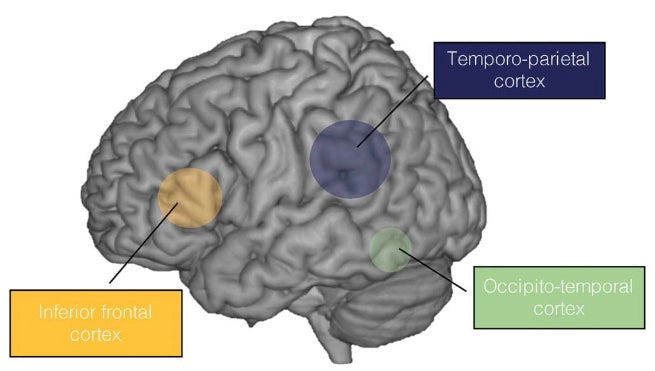
A brain model with three reading regions marked: inferior frontal, temporo-parietal, and occipito-temporal cortex

Cognitive Neuroscience of Dyslexia

A review of the imaging research. Children with dyslexia show differences in the structure and connectivity of the brain’s reading circuits, visible before reading instruction begins, and those circuits change with effective instruction.

D’Mello & Gabrieli, Language, Speech, and Hearing Services in Schools (2018)
Read the paper
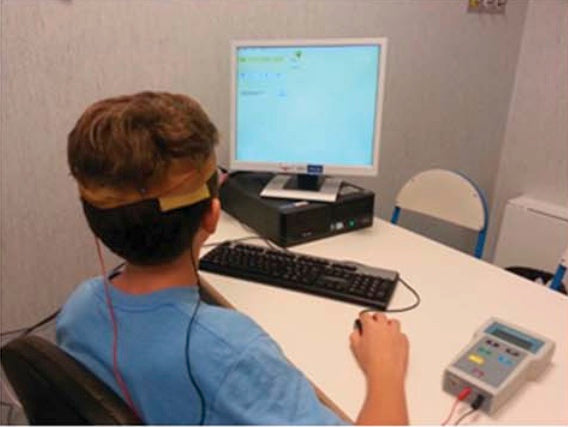
A child wearing stimulation electrodes reads at a computer during a training session

First randomized trial in youth with dyslexia

Eighteen sessions of tDCS paired with cognitive training reduced low-frequency word errors and non-word reading times in children and adolescents with dyslexia. Gains held at one-month follow-up.

Costanzo et al., Restorative Neurology and Neuroscience (2016)
Read the paper
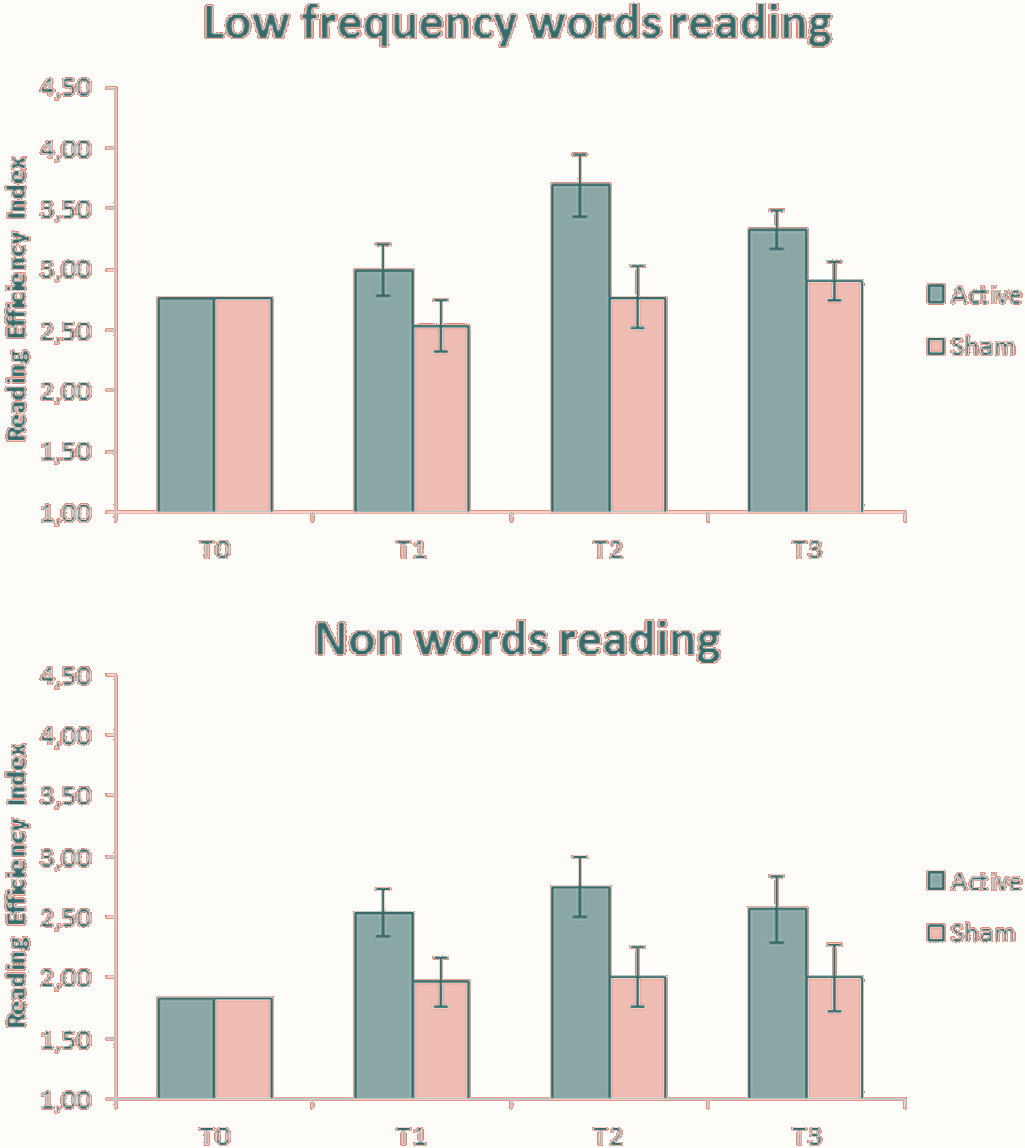
Bar charts showing active tES outperforming sham on low-frequency word and non-word reading across four timepoints

Reading gains held over six months after treatment

Eighteen sessions of tES paired with phoneme-grapheme training produced low-frequency word and pseudoword reading gains that persisted at six-month follow-up.

Costanzo et al., Neuropsychologia (2019)
Read the paper
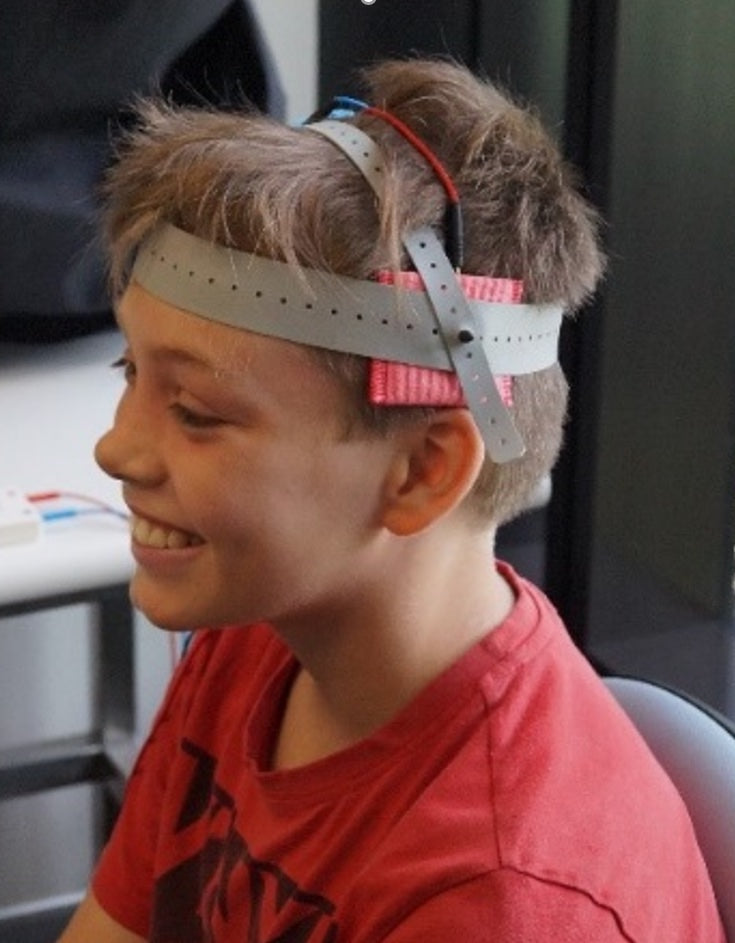
A smiling child wearing a stimulation headband with sponge electrodes during a session

Eleven studies with positive reading outcomes.

A 2025 scoping review of the entire tES-for-developmental-dyslexia clinical literature (225 participants total). Strongest, most consistent signal on non-word decoding.

Constantino et al., CoDAS (2025)
Read the paper
After one 14-minute sessionShamActive20% fewerReading errors · sham: 3.85 % of words (no stimulation 3.91)Reading errors · active: 3.07 % of words (bilateral montage 3.10), p < .001 vs sham3.853.07Reading errors% of words13% fasterReading time · sham: 1.23 seconds per word (no stimulation 1.22)Reading time · active: 1.07 seconds per word (bilateral montage 1.08), p < .001 vs sham1.231.07Reading timeseconds per word38% moreWords recalled · sham: 4.88 of 15 (no stimulation 4.80)Words recalled · active: 6.71 of 15 (bilateral montage 6.24), p < .001 vs sham4.886.71Words recalledof 1517 children, each tested in every condition · all p < .001 vs sham

Reading gains tracked auditory-processing gains

One session of anodal tDCS over left superior temporal gyrus in dyslexic children improved auditory temporal processing, speech-in-noise perception, verbal memory, and reading, with reading improvements statistically tied to the underlying auditory gains.

Rahimi et al., Neuropsychologia (2022)
Read the paper
Non-word reading time (s)ActiveSham36384042BeforeAfter1 week1 monthSham · Before: 38.29 sSham · After: 38.08 sSham · 1 week: 37.09 sSham · 1 month: 37.23 sActive · Before: 41.96 sActive · After: 36.96 s (p < 0.01 vs before)Active · 1 week: 38.52 sActive · 1 month: 37.00 s (p < 0.01 vs before)42.038.337.0*37.0** p < 0.01 vs before · lower is faster · 24 participants, crossover

Five daily sessions, effects held at a month

A crossover trial in 24 children and adolescents with dyslexia: five consecutive daily tDCS sessions produced non-word reading speed gains sustained at one-month follow-up, evidence a short, deployable protocol is enough.

Battisti et al., Frontiers in Psychology (2022)
Read the paper
Text reading speed (syll/s)ActiveSham3.54.04.55.0BeforeAfter 10 days4 weeks laterSham · before: 3.82 syllables per second (SD 0.85, n = 9)Sham · after 10 days: 4.57 syllables per second (SD 1.00, n = 9), significantly above its own baseline4.6*Sham · 4 weeks later: 4.19 syllables per second (SD 0.44, n = 9)4.2Active · before: 3.81 syllables per second (SD 1.11, n = 11)3.8Active · after 10 days: 4.22 syllables per second (SD 1.05, n = 11), significantly above its own baseline4.2*Active · 4 weeks later: 4.53 syllables per second (SD 1.03, n = 11), significantly above its own baseline4.5** p < .05 vs own baseline · bars ± SEM · 11 active, 9 sham · both start at 3.8

Stimulation made reading-speed gains last

A randomized, sham-controlled trial in 20 university students with dyslexia: ten daily sessions of rhythm-based reading training with concurrent tDCS. Both groups read text faster right after training. Four weeks later, only the active stimulation group was still significantly above its starting speed.

Cancer et al., Brain and Cognition (2026)
Read the paper
Correct answersBeforeAfter0204060Non-words · before: 16.70 correctNon-words · after: 18.70 correct (p = .035)16.718.7Non-wordsp = .035 · n = 10Words in text · before: 43.11 correctWords in text · after: 48.11 correct (p = .012)43.148.1Words in textp = .012 · n = 9After 5 sessions · one group, no control

Five sessions improved reading accuracy

In 12 children and adolescents with dyslexia, five consecutive tDCS sessions increased correct responses for pseudowords and text. The one-group pre/post study reported average gains of 43.6% and 32.2%.

Rios et al., Child Neurology Open (2018)
Read the paper
Text reading speed (wpm)050100Active · before: 99.2 words per minute99BeforeActive · after: about 105 words per minute≈105AfterActive · 1 week after: 114.3 words per minute1141 wkActiveSham · before: 98.1 words per minute98BeforeSham · after: about 100 words per minute≈100AfterSham · 1 week after: 91.3 words per minute911 wkShamp = .0119 adults · 5 sessions · ± SEM as published

Adults read faster a week after stimulation

Nineteen adults with dyslexia received five sessions of active or sham tDCS over the left visual motion area across two weeks. One week after treatment the active group read text at 114 words per minute against 91 for sham, with no loss of accuracy. Rapid number naming also sped up with active stimulation only.

Heth & Lavidor, Neuropsychologia (2015)
Read the paper

Double Blind Placebo Controlled RCT of NeuroLingo Brain Stimulation on Children with Dyslexia

General Neuro, in progress (2026)

Who we are.

Alec Sheffield
Alec Sheffield
Luke Knoble
Luke Knoble
Zida Sung
Zida Sung

General Neuro was founded at Yale by Alec Sheffield, a computational neuroscientist (PhD, Yale) who trained in brain stimulation at Harvard’s Berenson-Allen Center, along with Luke Knoble and Zida Sung, computer and electrical engineers from Virginia Tech, who build the headband and stimulation circuitry. We are a public benefit corporation, based in Boston and backed by SOSV / HAX. We have been building brain-stimulation headbands since 2024. More than a hundred of our first-generation headbands are in use in 22 countries, and our next generation headband is now at two pilot sites.

Advisors

Dr. Joseph Knoble, M.D.
Dr. Joseph Knoble, M.D.Chief Medical Advisor

Former Chief Fellow at Yale Psychiatry. Clinical advisor for NeuroLingo.

Jennifer Golden
Jennifer GoldenCurriculum & Assessment Advisor

Certified Orton-Gillingham Specialist since 2003, Reading Specialist, Special Education Teacher, and founder of Golden Advantage Education.

Our ongoing pilots.

Jennifer Golden

Decoding, reading, and phonological awareness

Golden Advantage Education · Montvale, New Jersey

Children with dyslexia use NeuroLingo during Orton-Gillingham tutoring at Golden Advantage Education, led by founder Jennifer Golden, a Certified Orton-Gillingham Specialist since 2003.

Golden Advantage Education ↗

Language learning

Virginia Tech Language and Culture Institute · Blacksburg, Virginia

English-language learners at Virginia Tech use NeuroLingo during their language classes in a randomized controlled trial.

Language and Culture Institute ↗

Find out if it’s right for your child.

Let’s go!
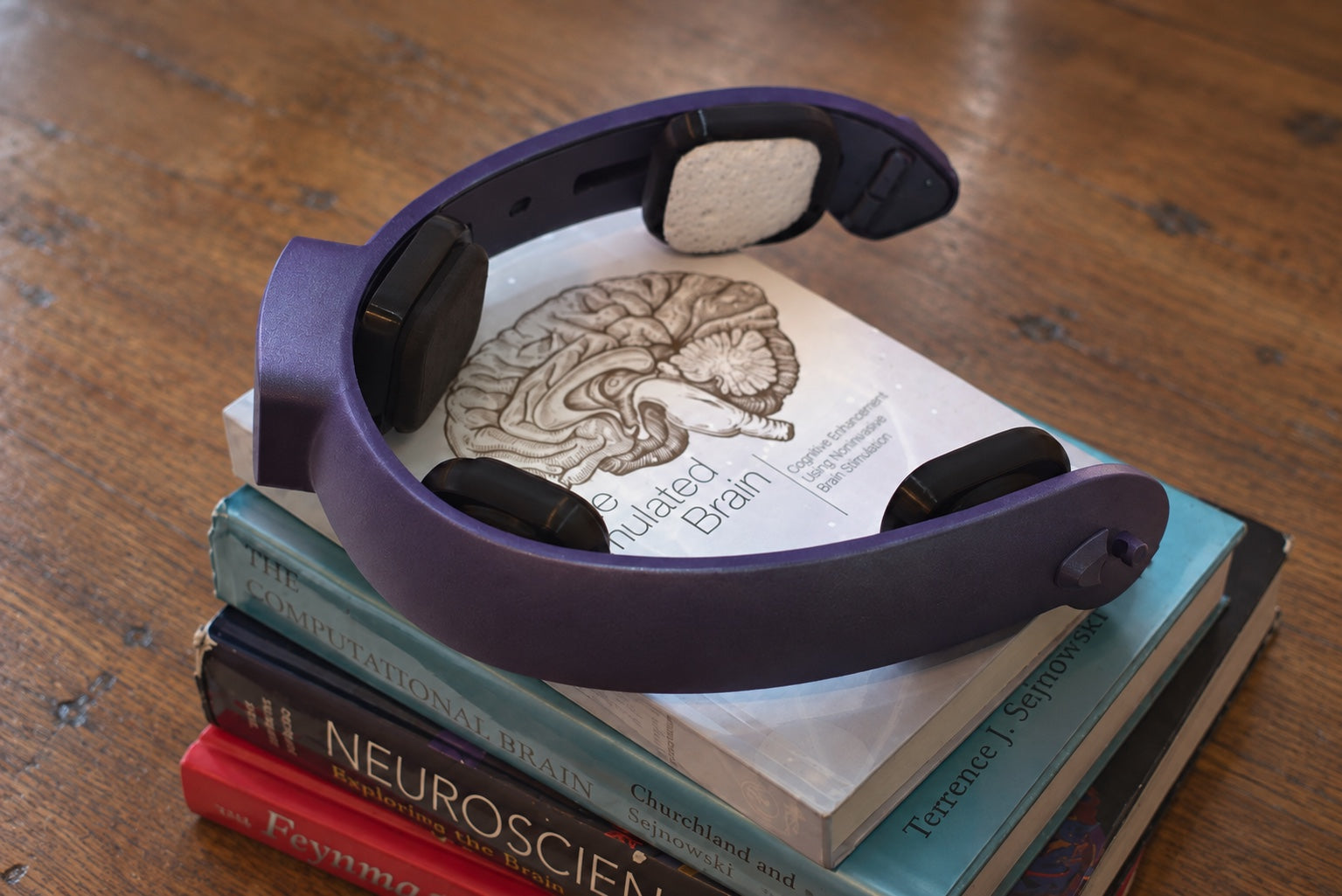
The NeuroLingo headband resting on a stack of neuroscience books

Questions.

Is it safe?

Stimulation at this level has been used in research for more than twenty years and in thousands of sessions with children. The most common effects are a tingling or itching under the pads for the first minute or two, and occasionally mild skin redness that fades. The headband is set to the lower current range used in child research, and sessions stop automatically.

What does it feel like?

A light tingle under the pads for the first few minutes, then most children stop noticing it. It is nothing like the shock from a doorknob.

How does it work?

Reading runs on a network on the left side of the brain. In children with dyslexia, those left-side regions are less active, and the right side steps in to compensate. NeuroLingo uses transcranial direct current stimulation, or tDCS, in which a small, steady current passes through two pads on the scalp. This makes the left reading regions a little more responsive and the right a little less. It also makes the brain better able to rewire while it is on, known as neuroplasticity. Paired with reading practice, that gives the practice more to build on. That is why the headband is worn only during practice.

Does my child need a tutor or a program?

Yes, in the sense that the headband is worn during reading practice and does not teach reading on its own. A tutor, a school program, at-home practice, or a structured program like Orton-Gillingham or Lindamood-Bell all count.

What ages?

We designed it for ages 6 to 17, but the research has been run on adults too: in one trial, adults with dyslexia read faster after five sessions (Heth & Lavidor 2015).

How much time does it take?

Three 20-minute sessions a week, during the decoding, reading, and phonological awareness practice your child already does.

Is it a medical device?

No. NeuroLingo is sold as a reading-practice aid and is not intended to diagnose, treat, cure or prevent any disease or condition.

When does it ship?

In 2027. We will announce the quarter when the production run is booked. If the date moves, you will hear from us first with the option to cancel and a full refund.

What happens to my reservation payment?

It is applied to your order when you complete it. If you decide not to order, or just change your mind, email us and it is refunded in full, at any time.

Can I return it?

Every order is refundable until the day it ships. After delivery you have 30 days to try it out.

Do you ship to my country?

The United States, Canada, the United Kingdom and Australia in 2027. Send us an email at info@generalneuro.com if you’re interested but outside these locations. Local taxes and duties are shown at checkout.

Can my child’s tutor be involved?

Yes, and we would like them to be! Tutors and teachers who serve low-income students can also apply for free headbands.

The kids who need this most can’t buy it. Let’s fix that.

A lot of the children who would get the most out of a headband are in tutoring programs and classrooms running on fumes. So we made it easy to sponsor one for a kid in need. Foundations, districts, employers, families with a soft spot for readers: all welcome. We’re a public benefit corporation, which means the mission is in our legal paperwork, not just our marketing.

How to help:

  1. You pick a number.

    One, ten, or a whole classroom.

  2. We get it to a tutor who asked.

    Tutors and teachers working with children in need apply, tell us about their students, and we send the headbands their way.

  3. A child in need gets it.

    Three times a week, in the tutoring they already get. Same headband as everyone else.