What the research says.
Non-invasive brain stimulation of this kind (tDCS) has been studied for more than twenty years, in adults and in children. Over the past decade, research groups in Europe and the United States have tested it in dyslexic children during reading practice. Multiple studies reported larger gains in reading than practice alone.
The foundational pediatric trials come from Dr. Costanzo’s group at Bambino Gesù Children’s Hospital in Rome (Costanzo et al. 2016, 2019), who paired reading training with a specific bilateral temporo-parietal montage: a gentle 1.0 mA current through two saline pads (left anode at P7/TP7 to support under-active reading circuits, right cathode at P8/TP8 to quiet right-side compensation) for 20 minutes, three times a week. NeuroLingo is built around the exact montage, pad size, and 20-minute protocol of the Costanzo group, custom-sized to your child’s head so the pads land on those same sites consistently at home.
Read the papers.
Studies on how the brain learns to read, and on what happens when stimulation is paired with reading practice.
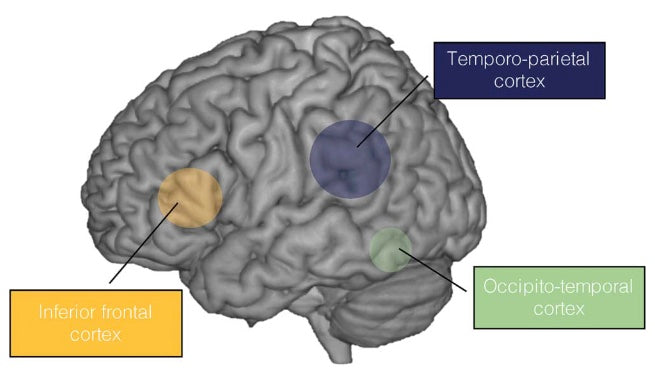
Cognitive Neuroscience of Dyslexia
A review of the pediatric imaging research. Children with dyslexia show differences in the structure and connectivity of the brain’s reading circuits, visible before reading instruction begins, and those circuits change with effective instruction.
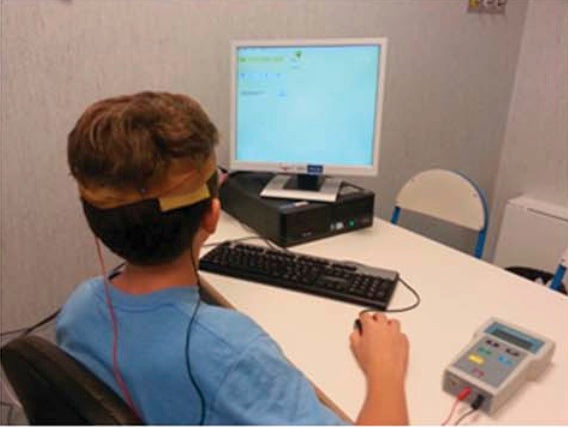
First randomized trial in youth with dyslexia
In 18 children and adolescents with dyslexia (ages 10–17), eighteen sessions of tDCS paired with cognitive reading training reduced low-frequency word errors and non-word reading times compared with sham. Gains held at one-month follow-up.
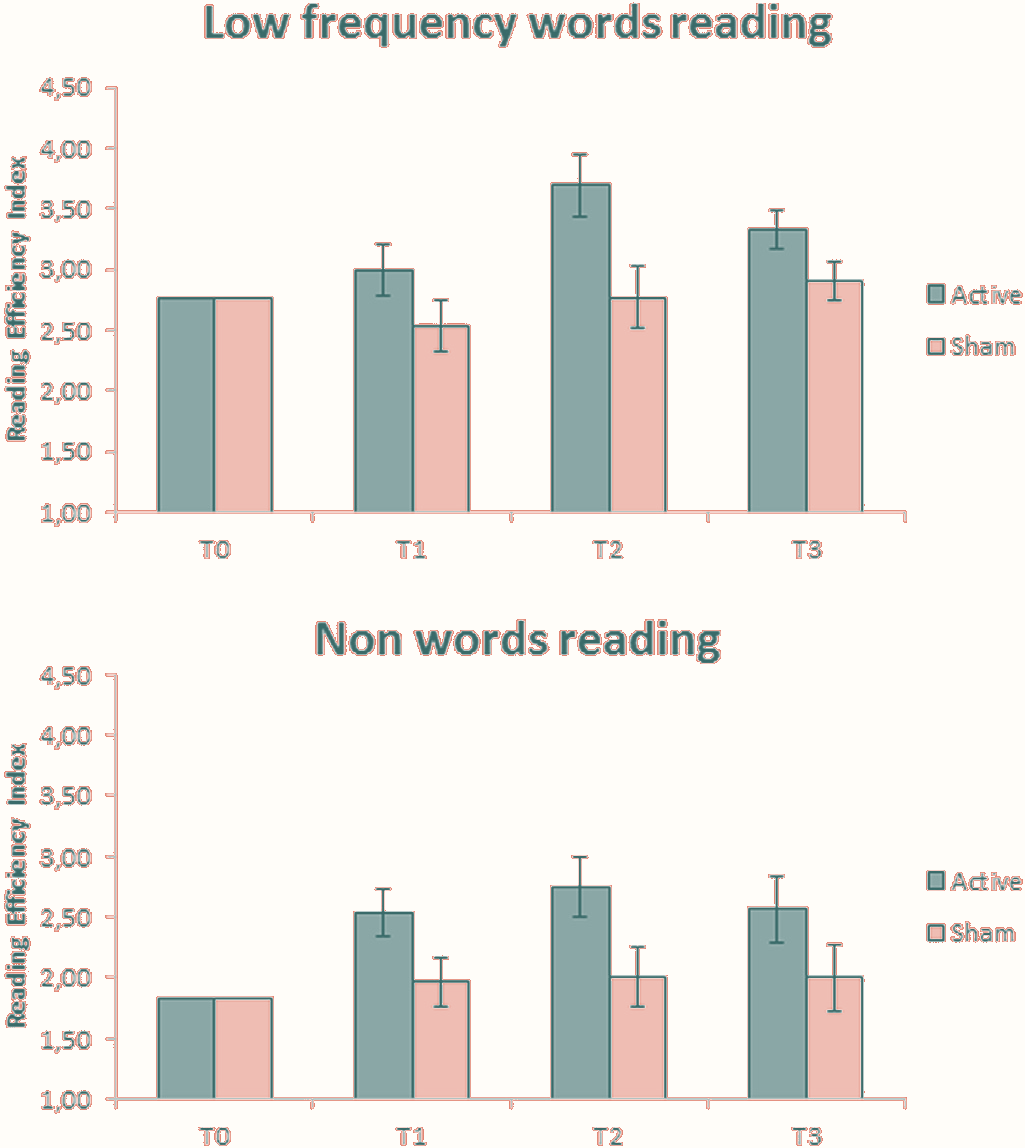
Reading gains held over six months after treatment
In 26 children and adolescents with dyslexia (ages 10–17), eighteen sessions of tES paired with phoneme-grapheme reading training produced low-frequency word and non-word reading gains that persisted at six-month follow-up.
Eleven studies with positive reading outcomes.
A 2025 scoping review of the tES-for-developmental-dyslexia clinical literature (11 studies, 225 participants total; 8 pediatric trials). Strongest, most consistent signal on non-word decoding.
Reading gains tracked auditory-processing gains
In 17 children with dyslexia (ages 9–12), one 14-minute session of anodal tDCS over left superior temporal gyrus cut reading errors by 20%, sped up word reading by 13%, and increased word recall by 38% versus sham, alongside gains in auditory temporal processing and speech-in-noise perception.
Five daily sessions, effects held at a month
A crossover trial in 24 children and adolescents with dyslexia (ages 9–18): five consecutive daily parieto-occipital tDCS sessions (without reading training) improved non-word reading speed versus baseline, held at one-month follow-up.
Five sessions improved reading accuracy
In 12 children and adolescents with dyslexia (ages 8–17), five consecutive tDCS sessions increased correct responses for pseudowords and text. The one-group pre/post study reported average gains of 43.6% and 32.2%.
Stimulation made reading-speed gains last
A randomized, sham-controlled trial in 20 university students with dyslexia (ages 18–26): ten daily sessions of rhythm-based reading training with concurrent tDCS. Both groups read text faster right after training. Four weeks later, only the active stimulation group was still significantly above its starting speed.
Adults read faster a week after stimulation
In 19 adults with dyslexia (ages 21–37), five sessions of active or sham tDCS over the left visual motion area across two weeks led to faster oral text reading one week after treatment (114 words per minute for active vs. 91 for sham, with no loss of accuracy). Rapid number naming also sped up with active stimulation only.

Double Blind Placebo Controlled RCT of NeuroLingo Brain Stimulation on Children with Dyslexia
Technical specifications.
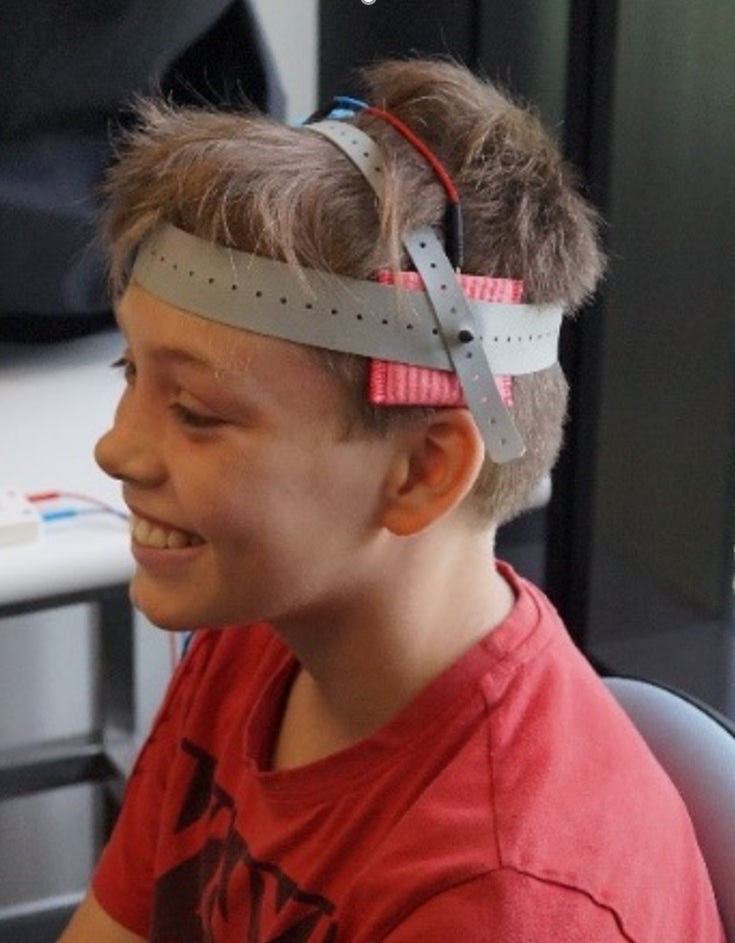
NeuroLingo replicates the exact bilateral temporo-parietal montage of the Costanzo group (Costanzo et al. 2016, 2019), with our patent-pending electrode positioning system. Two single-use 5 × 5 cm (25 cm²) saline sponge pads sit over the left (P7/TP7, anode) and right (P8/TP8, cathode) reading regions. Each session ramps up over 30 seconds to a regulated 1.0 mA direct current (0.04 mA/cm² current density), runs for 20 minutes, and ramps down over 30 seconds before shutting off automatically, with an on-device daily lockout restricting use to one session per day.
Continuous closed-loop impedance monitoring checks pad-to-scalp contact throughout the session: if a pad lifts or begins to dry out, the headband automatically ramps current down to 0 mA, pauses the timer, and alerts you with a light and vibration cue until contact is restored. The headband uses a custom-sized nylon/PLA frame, closed-cell foam padding, medical-grade biocompatible silicone holders, and conductive carbon electrodes; it runs on an internal rechargeable lithium-ion battery with a hardware and firmware interlock that blocks stimulation whenever a USB charging cable is plugged in, uses FCC Part 15 pre-certified wireless modules, and is engineered to LOTES-2023 (Bikson et al. 2023) and IEC 60601-1 / 60601-2-10 medical electrical safety design standards to deliver the optimal stimulation at home and in our IRB-overseen trials.